Barney Ronay-type beat

Getting ahead of one journalist’s reaction to Manchester City’s likely treble triumph next month 

For a moment last night Pep Guardiola appeared to be moulding spacetime like putty in his hands. Gesturing on the sideline as he spoke to oncoming substitute Julian Alvarez, it felt like all of reality was bending to his will, that the instructions he was giving were actually just previews of a future he could already see, eternity stretching out in front of him as it would to a Tralfamadorian. 

By this time, the treble was won. Manchester City were 2-0 up and cruising in this weirdly flat game thanks to İlkay Gündoğan and Riyad Mahrez. The oles from high up in the Atatürk accompanied each City pass like rites being administered in a coronation ritual for this genuinely great side. The noise rushed down and dispersed out through the stadium’s exposed end which siphoned it off into the heavy Istanbul night. 

Guardiola and City have succeeded in rationalising the world’s most popular pastime. This seven-year exercise in eliminating risk, jeopardy, and everything irrational, has reached its inevitable end. Everything in its right place. 

Of course, there are caveats. City’s über-professional hunting down of a flailing Arsenal side in the league looks from the perspective of now like a historical inevitability. But City spent the long middle part of this stretched-out season looking like they might phone it in after winning those titanic battles with Liverpool, the equivalent of Jacques Anquetil seeing off Raymond Poulidor only to lose to a seal on a unicycle.

There were flings with imperfection, with beauty, for the ‘intangibles’ to take control: backs-to-the wall comebacks were required against Palace and Spurs. Anfield did Anfield things to City. Frank Lampard, Steven Gerrard and a banter-era Antonio Conte took points off Guardiola, and Nathan Jones denied them a possible quadruple in the League Cup. Chris Wood scored at one point, which was fun. 

These are throwaway footnotes in the canon now. In the season’s final quarter, City compressed Arsenal in the manner that their players do the opposition when they have lost the ball, blue antibodies converging on and neutralising the foreign red object. Guardiola’s goodwill with his former mentee ran out: he is the Nucky Thompson to Arteta’s Jimmy Darmody.  

On the pitch, City did not undergo any kind of revolution this season in claiming the treble, they merely fine-tuned what was already an exercise in near-sublimity. In possession they create geometric shapes from passing lanes which constantly morph into others before the observer can even make them out, trapeziums into diamonds into triangles. Kevin de Bruyne strides around, all colour and right angles. Fizzing all around him, Gündoğan and Bernardo Silva prove the theory of perpetual motion in a closed system. Erling Haaland’s record-chasing has inadvertently introduced the TikTok generation to Pathe news clips of Dixie Dean, Fred Morris, Joe Smith: strikers who played in an era when England had never lost to European opposition.  

The fifth part of their defining quintet of home victories (United, Leipzig, Bayern, Arsenal) came against Real Madrid, who they not so much beat in a football match as they did deconstruct their reason for being and then send the analysis back to them in a shared Google Doc. Erving Goffman would have liked City; they are the JL Austin of football.  

Manchester United put up more of a fight in the FA Cup Final, a kind of legacy act trying to defend the honour of their fabled ancestor deities like Norse soldiers, but they couldn’t cope with City’s relentless motorik rhythm. For United, this week was the realising of their worst fears, their Ragnarök.  

The 115 charges levelled against City by the Premier League will be neither proved nor disproved any time soon, despite Guardiola’s wishes for a speedy process. On this, the Abu Dhabi United Group and the manager do differ. The City ownership’s gunboat diplomacy in its dealings with the footballing authorities can be handily reframed as an overdue pushback against the ‘Cartel’ deep-state of established clubs. This unavoidable context surrounding City’s achievements should continue to be highlighted by a responsible media, although it won’t go down well: you’ll get a less frosty reception at an Etihad presser if you turned up in a Just Stop Oil t-shirt clutching a can of paint.  

Setting that aside for a second (which really ought to be the tagline for this thing), there is a wider question with the game which many neutrals may be feeling increasingly: who is this all for? City’s exploits this season and their domestic dominance are not without precedent in the English game, but its coupling with the smokescreen of creeping corporate discourse does give it a flavour of Football Realism, Big Football’s lackeys imbuing a sense within ordinary fans’ heads that there is no alternative. Cry more, Ronay! How’s that copium?! If you want a picture of the future, imagine an overly caffeinated posh twenty-something in a 90s football shirt on a livestream shouting at you to place an accumulator, forever. Performative, mawkish, cynical, it seems to say to those outside football’s elite: you can never attain this, but you must respect the greatness.  

This all goes on while we play host to proxy displays of hard power by nations fighting a kind of cold war in the Arabian Peninsula. Leaders in the UAE and Saudi Arabia, possibly soon to be joined by Qatar, use the Premier League as a stage to enact their psychodramas, and there is a sense here of just feeling fortunate to be involved in it all. Isn’t it nice that they see us as important enough, as worthy? Isn’t it pretty great optics? This is Global Britain. All that matters is that as we are invited to the summit, getting the exclusive sit-downs with the strongmen, happy to play host to something totally out of our control or comprehension. On the pitch in Istanbul after the final, Guardiola said that this is an era ‘we are all so lucky to be living through’. Do you feel it? 

Cheer up, it might never happen

Lives and half-lives at C-on-Sea

They fleck the landscape here – emerging from roadside bushes, attaching themselves to stiles, clinging to village notice boards. These red, green and yellow signs look like flags you might see swaying in front of Glastonbury’s Pyramid stage. CHAOS COAST COMING SOON, they say. NUCLEAR DISASTER AHEAD. IT’S NOT TOO LATE TO STOP SIZEWELL C. Are they right?

Stop Sizewell C is the campaign name for the Theberton & Eastbridge Action Group on Sizewell (TEAGS), who were formed a decade ago during Sizewell C’s nascent consultation phase. As the group’s handiwork suggests, their main concerns are with the disruption to the surrounding area which a new plant would cause. TEAGS Ltd Executive Director Alison Downes claimed to sum up locals’ memory of Sizewell B’s construction thirty years ago in testimony given to the government’s Planning Inspectorate: ‘it was terrible, but we survived’. The much larger Sizewell C project threatens a return to these troubled years.

Nowadays Nimbyism is defended by those proudly reclaiming the term almost as much as it is used in its original form, to direct blame for the UK’s lack of ambitious modern infrastructure projects. The thought process behind it is understandable on a human level. Some people move to quiet, picturesque places because they value serenity and natural beauty. Nimbys’ detractors might accuse them of myopia and selfishness. In response may come the question: when was the last time you consented to worsen your living situation for the greater economic good of the country?

Locals such as the actor Bill Nighy and the late presenter Bill Turnbull have made public their opposition to Sizewell’s expansion plans, just as AJP Taylor, one of the twentieth century’s most important British historians, had opposed Sizewell A. This part of Suffolk promises quiet in the winter and a sunny coast in summer for the famous and the recognisable. Unfortunately for them, energy consortiums have similar taste.

The biggest milestone in Sizewell C’s development to date came last year when then-business secretary Kwasi Kwarteng granted a Development Consent Order (DCO), as required for Nationally Significant Infrastructure Projects (NSIPs). The project, part-owned by the government, is headed by NNB Generation Company (SZC), a subsidiary of EDF which also owns Hinkley Point C. The new Sizewell site would be a ‘replica’ of the European Pressure Reactor design being constructed at Hinkley, and its two reactors would collectively produce 3.2GWe – just over half of the UK’s current total nuclear capacity. It is currently seeking further investment and will announce a Final Investment Decision (essentially the final say on the matter) by 2024.

In making his decision, Kwarteng appeared to go against recommendations made by the Planning Inspectorate to pause plans until problems related to water scarcity and habitat destruction were solved. The examining authority stated,

‘unless the outstanding water supply strategy can be resolved and sufficient information provided to enable the secretary of state to carry out his obligations under the Habitats Regulations, the case for an order granting development consent for the application is not made out.’

In his decision letter, he argued that Habitats Regulations can be overridden where there are Imperative Reasons of Overriding Public Interest (IROPI) and there are ‘no feasible alternative solutions’ to the plan. A few months after the decision, with Kwarteng now chancellor, Sizewell C was placed on a list of infrastructure projects to ‘be accelerated as fast as possible’ by ‘minimising the burden of environmental assessments’ and ‘reforming habitats and species regulation’. Unlike with some of the more infamous ideas from that ‘mini-budget’, there has been no renunciation of this one from the government.

Like many parts of the UK, Sizewell is in a ‘seriously water stressed’ area. The North Sea provides a ready and endless supply of saltwater to cool the steam produced by the reactor, but this water is too corrosive to be mixed with concrete during construction and it lacks the purity to be used in the stage of the process where nuclear fission heats it into steam. Sizewell C will need a supply of about four million litres of ‘potable’ water a day during construction, and then a constant supply of more than two million daily during its lifetime. The government were convinced by EDF’s pledge to build a temporary desalination plant during construction to purify seawater, reducing the strain on local water supply.

Sizewell lies in the Suffolk Coastal parliamentary constituency, a Conservative seat which has been represented since 2010 by Thérèse Coffey. Now the environment secretary, Coffey herself has made her own contribution to mains water-based discourse in her helpful social media interactions with Premier League footballers. Regarding Sizewell C, she joined the RSPB in questioning the granted DCO in light of the Planning Inspectorate’s observations. Immediately to the north of the proposed site lies RSPB Minsmere, a thousand-hectare nature reserve protected by law. It is one of only five UK recipients of the Council of Europe’s Diploma for Protected Areas award, the Council calling it ‘the most important bird reserve in the United Kingdom’. Minsmere is an incredibly diverse mix of rare habitats and is home to significant populations of protected bird species like the bittern, marsh harrier, turtle dove, and avocet. Living a few miles from the reserve means I hear birds that I have never heard before from my window like nightingales. The potential change in the water table, water quality and seawater temperatures, as well as EDF’s reclamation of eight hectares of the Sizewell Marshes Site of Special Scientific Interest for building work, could trigger prey population collapses. Coffey stated that she was ‘surprised’ by the DCO’s decision to evoke an IROPI to override these concerns and that she ‘expect[ed] that applications will go to the High Court’. Go to the High Court they did, with Together Against Sizewell C (another key pressure group) initiating a legal challenge taking place in March this year where the court considered the possibility of a judicial review of the DCO decision. At time of writing, the ruling is still not known.

But Coffey’s vague gestures of dissent during the consultation process are tinged with a subtext. Yes, increased water abstraction in an already parched region during the early part of construction is bad. Lost hectares of wetland habitats are regrettable. Increased train screech and light pollution on the East Suffolk rail line (she herself claims to live 250 metres away) will be annoying. Turning off your driveway onto the B1122 will get more difficult with all those HGVs thundering by. But. These aren’t really the kinds of costs she has in mind when considering the project. It would take something stronger than these local interest groups’ concerns to change her position. Simultaneous catastrophic meltdowns at all of the UK’s current active reactors, say.

There are other issues. Despite the length of its consultation and construction phase, the decades it would be operational for, and the centuries it would stand, Sizewell C’s fortunes are susceptible to the world events of today – seismic in geopolitical terms but ephemeral in the context of nuclear time. As part of the rush to reduce Chinese involvement in UK infrastructure, the government had to buy out China General Nuclear’s 20% stake in the project. And in the context of the war in Ukraine, EDF will look elsewhere for fuel sources once pre-war Russian stocks of uranium run out. Laudable, though it would still necessitate dependence on uranium imports from the US, Canada, Australia and the DRC; and, of course, the plant itself will continue to be owned by the French state.

The longest-term problem, one which will continue long after Sizewell C stops generating power, is the on-site storage of spent fuel and waste. Sizewell C would cease operations at the end of this century and EDF’s applicant assessment assumes that all spent fuel will have been removed from the site by 2140. There are reasons to doubt this optimistic appraisal, not least the Nuclear Decommissioning Authority’s (NDA) own assessment in 2014 that the last spent fuel would not have cooled enough to be removed from the site until at least 2180 – around the time that the asteroid 101955 Bennu has a 1-in-2,700 chance of impacting Earth – or even well into the 23rd century.

Since then, the Office for Nuclear Regulation (ONR) revised the necessary waste cooling time for Hinkley Point C (an identical reactor) down to 55-60 years, which when applied to Sizewell C would put a decommissioning date of roughly the middle of next century, but this still puts it at odds with the NDA’s figure. Nick Scarr, a consulting engineer for the Nuclear Consulting Group, also questioned the EDF and ONR estimates in papers submitted to the Planning Inspectorate and the now-defunct Department for Business, Energy and Industrial Strategy. As he points out, the revision is based on series of assumptions such as either nuclear plant ceasing operation with no lifetime extensions, a Deep Geological Repository being commissioned and constructed somewhere in the UK to store high-grade waste by 2130, and all ‘legacy nuclear waste’ produced at the current Sizewell and Hinkley sites having already been disposed of. So far, no site has been found for deep-level waste burial, in a process which included local communities and councils being asked a decade ago to volunteer themselves as potential sites. Barring the residents of Sellafield in Cumbria (already a site of surface-level nuclear waste disposal for decades), there were no takers, and Cumbria County Council rejected the idea in 2013. Perhaps deep (deep, deep) down, we are all Nimbys.

.

Over the warm Easter weekend, the beach at Sizewell attracted families from nearby Leiston and further inland who walked through the thick sea fret, among the yellow horned poppies, gorse, and the occasional adder. So thick was the fog that Sizewell B’s distinctive white dome was invisible, and you could just make out the Hi-Viz jackets of G4S men who flanked the site. The dome is Sizewell’s primary focal point and can be seen from miles away up the coast, likened by WG Sebald in The Rings of Saturn to the Dome of the Rock at the Temple Mount in Jerusalem ‘shining like a shrine’ at night. To me it looks like a giant light sensor on an exposure meter, to Coffey it is ‘iconic’, to the cultural theorist Mark Fisher it was ‘bizarre’. Its clumsy juxtaposition with the dull brown cube of Sizewell A (Sebald: ‘a glowering mausoleum’) is a contrast often found among faculty buildings on red brick university campuses.

On that April day, the site seemed to stand as quietly as possible behind the murk so as not to be noticed, and the assorted walkers obliged, heads bowed or looking only out to sea. Leiston is a five-minute drive inland, the closest town to the plant. It looks like many other towns on the Suffolk coast. It felt more keenly than anywhere the effects of the construction of Sizewell A and B, which opened in 1966 and 1995, respectively. Sizewell B is the UK’s only pressurised water reactor, and may be the only operational nuclear power station of any kind for a time at the end of this decade. A contemporary study of Sizewell B’s seven-year construction found that the nature of complaints about the process from locals and in the local press evolved over time. Predictably, increased road traffic was the primary source of anguish in the early years, before the issue of antisocial behaviour by Sizewell B employees in the Leiston area became prevalent later on. Overall, though, it is noteworthy that total complaints to Nuclear Electric (formerly the Central Electricity Generation Board) reduced significantly over the course of the project. Oxford Brookes’ John Glasson argues that a kind of fatigue may have played a part in this: ‘This process — learning to live with Sizewell B — may partly reflect an acceptance of the inevitability of the project and an adjustment to its impacts’. Curiously, this acceptance may have permanently altered those residents’ outlook on the reality of nuclear power on their doorstep. In the present day, locals surveyed who had lived in the area during Sizewell B’s construction were ‘significantly more supportive’ of Sizewell C than those who had not.

Coffey and those on East Suffolk Council (the parliamentary constituency and council borough have roughly similar borders) impress upon the local population the economic boon that Sizewell C would be. During consultation Coffey has repeatedly stated its importance ‘for local prosperity given the low average income in this part of Suffolk and the country’. The Council predicts 2,000 home-based workers (those who live in a ninety minute radius) could be employed on-site at the peak of construction, adding £700 million of Net Value Added to Suffolk’s economy. History suggests that the project will boost the local workforce to an extent: during Sizewell B’s construction, around half of workers came from within daily commuting distance of the site. An importing of a significantly-sized workforce seems likely for this project, too. SZC Co.’s assessment that ‘With the right timing, there can be a direct transfer of skills from Hinkley Point C to Sizewell C’ was noted by Downes with alarm in her testimony to the Planning Inspectorate.

The construction process for nuclear reactors moves at a glacial pace. The expenses involved can deter large investors, and each stage of a project tends to be accompanied by protests which attract sympathy (if not always outright support) by the generations which remember the Chernobyl disaster and other near-misses. In recent years the planned reactors at Wylfa and Oldbury were cancelled after Horizon Nuclear Power (owned by Japanese conglomerate Hitachi) withdrew its planning application despite the UK government offering to take a one-third stake in the project. The privatisation of power generation and liberalisation of the UK’s energy market in the last thirty years has hampered many similar projects. Operable nuclear capacity has fallen from its late 1990s peak – when it commanded a 26% share of the UK’s electricity mix – and is now similar to 1970s capacity, at about 16%. But things might be changing. The government is hoping that a Regulated Asset Base (RAB) funding mechanism, which places less risk on investors by transferring some of their upfront construction costs to the consumer end, can jump-start their push to build eight new reactors by 2050, which would increase the nuclear power share back up to 25% of the UK’s electricity demand.

Like an optical illusion, nuclear energy has signified different things to different political eras. Despite fears shaping perceptions in the aftermath of Chernobyl and Fukushima, nuclear has done well out of subsequent international agreements on climate change, re-framing itself as the only viable alternative to fossil fuels. Successive governments since New Labour have re-affirmed their commitment to replenishing Britain’s nuclear stock. Certain lessons are being selectively learned from the current Russo-Ukrainian war, at the expense of others. It is said that the war proves the need for homegrown nuclear energy to reduce our dependence on energy sources from unconscionable regimes, while overlooking the dependence on uranium imports that the conflict has also highlighted, and the dangers of nuclear reactors being used as bargaining chips should the area around them become active warzones, as has happened with the Zaporizhzhia plant.

This is not to say that there is a clear preferable alternative. After Fukushima, Germany accelerated its nuclear phaseout, but it is still grappling with its addiction to Russian gas and to coal – the latter is still its second-largest electricity source. The artist Joanie Lemercier has documented the impacts of the Hambach surface coal mine in North-Rhine Westphalia, the largest single site of greenhouse gas production in Europe. In the video installation Slow Violence, forlorn footage shows machines dismembering the land, with giant excavators scraping away at rock strata, exposed like gingival recession on a tooth. The mine continues to expand: into the 12,000-year-old Hambach forest, 90% of which has already been cleared since mining began; and straight through villages in the surrounding area, which are routinely razed to make way for it.

As for domestic renewable energy, the UK is still some way off having the kind of storage capacity needed to totally rely on energy sources like wind or solar. Issues of retaining wind energy, transporting it, and building the battery capacity to contain it for when there are spikes in usage, are a way off being fully addressed. Nuclear power has readymade answers to these quandaries. But it is these renewable technologies as well as relatively simple demand-side approaches that will play a greater future role in addressing the energy and climate crises. Wind and solar together already outstrip nuclear as contributors to the UK’s electricity mix (25%). Policymakers may prefer building these more eye-catching monuments to renewable energy creation over scaling back consumption, confusing an absence of action with lack of ambition. But as Together Against Sizewell C’s Pete Wilkinson points out, a simple measure applied nationally like replacing all incandescent and halogen bulbs with LED ones would cost an estimated £1.6 billion to do, a fraction of the price of building a power station like Hinkley Point C, and would save annually the equivalent of the Hinkley’s total output. Both approaches will need to be used, and nuclear energy still makes sense in the short-to-medium term.

Nuclear is an old technology. It was already beginning to date when Sizewell B first went on the grid. The first civil nuclear power station went operational at Calder Hall in 1956, and power station cooling towers conjure images of background shots in British New Wave films. Perhaps, then, this mid-century invention can enjoy its swansong in the most constructive way, acting as bridge between old and new energy sources. The question remains, will the future see it the same way?

.

In March, I found myself in a large bare room with people wearing brown corduroy jackets and beanies indoors watching short art films about this topic. The Art Station in Saxmundham was hosting ‘The Nuclear Programme’, a series of films curated by the artist Emily Richardson to coincide with her Immaterial Terrain project. Mark Aerial Waller’s Glow Boys (1998) imagines a world where over-exposed nuclear workers become superhuman and immune to radiation’s ill effects. The title references a real-life term (see also: Nuclear Nomads, Luminizers, Liquidators, Gamma Sponges) for nuclear contract workers who jump between power plants once they have exceeded the legal maximum exposure to be able to continue the dangerous but well-remunerated work. In the film, the claustrophobic interior of the power plant has become their permanent habitat because sleep and other mortal concerns are no longer necessary. A middle-era Mark E. Smith is cast as a canteen worker who serenades Worker 508. The film’s soundtrack features a cybernetic-tinged cover of The Fall’s ‘Free Range’.

The mystery of nuclear energy has piqued artists’ curiosity since the war. Glow Boys highlights its strange contradiction: a process which is ‘the harnessing of the basic power of the universe’ as President Truman put it in August 1945, but which is also quite mysterious and banal. The first nation in the world to industrialise, Britain is defined by the crash and bang of industry, whereas a nuclear power plant, represents a neutering of this spirit. Walking past Sizewell’s smooth monolith, its only perceptible emission is a kind of tinnitus hum which gets lost in the wind coming in off the North Sea and over the marshes.

Nearby Dunwich, too, has attracted artistic and intellectual fascination for centuries. JMW Turner, Algernon Charles Swinburne, Brian Eno, WG Sebald, and Mark Fisher have reflected on its slow capitulation to the sea. A major medieval trading port, it is estimated that a quarter of the fleet that sailed to the crusades in 1230 originated there. A series of catastrophic storms in the late thirteenth and early fourteenth centuries did for Dunwich, depositing shingle across its harbour entrance which blocked incoming trade, making it no longer worth saving with sea defences. Over the following 700 years, the sea has eroded Dunwich so that almost the entire town, including around ten churches, is now underwater. Looted by Henry VIII’s Anglican reformers in the sixteenth century, designated as a Rotten Borough in the nineteenth, Dunwich now promotes a policy of ‘managed retreat’ – that is to say, the final stage of grief. ‘If you look out from the cliff-top across the sea towards where the town must once have been, you can sense the immense power of emptiness’, said Sebald.

Dunwich and Sizewell are linked inextricably. For both sites, the sea has and will bring opportunity and danger in unison. Sizewell lies five miles down from the town and is sheltered by Dunwich bank, an offshore mobile sand bank which significantly reduces wave energy before it impacts the shoreline. EDF and SZC Co. may be taking this breakwater for granted. In their own research they quote Pye and Blott (2005) who state that from 1736 to 1836 Sizewell was ‘the most eroded shoreline in the records’.1 In that hundred-year period, the shore had receded 300 metres. From 1836, cliff erosion at Dunwich deposited sediment at sea which formed the bank, and the Sizewell shore grew back more than 80 metres to where it currently stands. The forming of the bank reversed Sizewell’s fortunes but its formation is susceptible to equally rapid disintegration: it has ‘no inherited stabilising hard geology (i.e., no headland or underpinning crag)’. Historians salivate at the thought of the bank moving landwards and revealing more of the ruins of the town on the seafloor, but for Sizewell it could be disastrous. Once more it would be exposed as one of the concentrated wave ‘energy foci’2 along the Suffolk coast, and history suggests the eighteenth-century incursion would resume.

Unsurprisingly, Sizewell C is being built with flood risk in mind. Its main platform will be over seven metres above sea level, and EDF seem to have accounted for possible future breakdown of Dunwich bank. In assessments obtained by Scarr under a Freedom of Information request3, they argue that reductions in the bank could actually help Sizewell in the accretion of more sediment southward: ‘releasing sediment to the system, the soft coastal defence will act to reduce erosion locally, particularly to the south as that is the main direction of sediment transport.’4

But their argument comes unstuck when considering two volatile factors which will become more prevalent in the coming centuries, regardless of natural defences: storm surges and rising sea levels. EDF/SZC Co. seem to have based their contingency plans on the RCP8.5 scenario – a climate change scenario adopted by the IPCC which imagines a temperature increase by 2100 of 4.3˚ C above pre-industrial levels (the Paris Agreement’s goal is to keep the rise well below 2 °C). RCP8.5 is intended by the IPCC as a worst-case scenario and has provoked scientific debate over its plausibility, but EDF nevertheless regard it as a ‘reasonably foreseeable5 eventuality.

Major storm surges, the other factor in this equation, are not new to the UK, as Dunwich knows historically. The famous North Sea flood of 1953 which battered Suffolk and killed 2,500 people is defined by the Environment Agency as a 1 in 1,000-year event at a height of 3.44 metres above sea level. However, EDF’s flood risk assessment addendum states that the 1953 flood ‘cannot be considered as especially extreme in the longer-term historical context’,6 and points out that in the twentieth century alone there were four roughly 1 in 200-year storm surges in the UK. Considering the IPCC’s assessment that ‘Extreme sea level events that previously occurred once in 100 years could happen every year by the end of this century’, this low-lying area will experience ever more frequent storm surges.

Under these assumptions, EDF’s worst-case scenario assessment combines a 1 in 10,000-year storm surge (5.73 ± 0.29m) with the RCP8.5 sea-level rise projection. They themselves admit that this scenario would lead to minor flooding of the Sizewell C site by the end of next century, should defences be breached or the surrounding low-lying areas flood:

‘Assessment of the extreme still water levels above main platform height (7.3m AOD), presented in Table 4.2, shows that for the 1 in 10,000-year event at 2190 epoch the flood depth on the platform is greater than the building threshold set in the design parameters and for the credible maximum climate change scenarios (i.e. BECC Upper) flood depths are significantly above the main platform height and threshold of the buildings.’7

They qualify this slightly: ‘the inundation would be limited to the peak of the surge event only, for a period of approximately 3 hours, and therefore the risk would also be time limited.’

This modelling of flooding effects makes a series of assumptions. Firstly, the assumption that by this time, all nuclear waste will be off-site: ‘it is anticipated that by this time i.e. 2190, there will be very limited (if any) activities on site and most buildings would be decommissioned and demolished.’ As already established, this is a contested claim. More strikingly, it favours the RCP8.5 ‘reasonably foreseeable’ scenario over the BECC Upper (British Energy Climate Change) scenario, the latter of which extrapolates from Met Office-recommended modelling. EDF cites BECC Upper as a ‘credible maximum’ but does not appear to use in its flood risk scenario. This is significant because the RCP8.5 and BECC Upper sea level estimates foresee dramatically differing flooding events. If sea levels rise according to the latter estimate, even a 1 in 200-year storm would be enough to inundate Sizewell C by 2190. Should a 1 in 1,000 or 1 in 10,000-year storm occur, Sizewell C would flood as early as 2140, and by 2190 flood levels would exceed 2.5 metres above the main platform.

As at Fukushima, seawater flooding the site could knock out electrical systems and prevent the reactor core from cooling, leading to overheating, meltdown, and release of radiation into the air and the water. Inundation could breach nuclear waste and spent fuel stores, dispersing it.

The bleak picture would require several worst-case situations to converge, but to consider them is ostensibly the purpose of contingency planning. This is especially true when a drawn-out process like the construction of a power plant is combined with constantly-changing climate change estimates. That EDF have arbitrarily rejected one extreme sea level rise model in favour of a more conservative one to use as the basis for its construction seems misguided. In whatever case, these risks bring into even sharper focus how narrow the window will be to remove all waste from and decommission the Sizewell site by its proposed deadline, and should increase the scrutiny placed on how exactly they plan to achieve this.

Nuclear time operates on a different scale to human time. Thinking about these faraway-seeming dates is to think about a world we will not inhabit. The Treasury has tried to quantify this feeling of detachment in its Green Book, a manual on how to appraise projects. It uses the ‘discount rate’ equation to measure the value of future generations against our own. A higher rate would mean paying less today at the expense of future generations. The part of the equation which signifies the value we place on the future is called the ‘pure time preference rate’ (δ), and it is 0.5% – meaning we discount future wellbeing at 0.5% per year. From where we are standing, we imply that those living 140 years from now (around the time of Sizewell C’s decommissioning) are half as important as we are.

δ is ‘based on the median result from a survey of experts’,8 though the IPCC finds that ‘a broad consensus’ of economists object ethically to any δ value greater than zero. To them, valuing people’s wellbeing based on when they live is as indefensible as doing it based on where they live. Seeing those who will live beyond us as our true equals is one of the most difficult but important acts when thinking about Sizewell C. Are we deferring a kindness to them, or a curse?


[1] (As cited by Scarr here) BEEMS Technical Report Series 2009 no. TR058, Sizewell: Morphology of coastal sandbanks and impact to adjacent shorelines. Page 40

[2] Institute of Oceanographic Sciences, Sizewell-Dunwich banks field study, Topic Report 6, Carr, King, Heathershaw and Leeds. Page 15

[3] Scarr p. 16 ‘BEEMS ‘British Energy Estuarine & Marine Studies’ including BECC ‘British Energy Climate Change’, are technical documents produced and commissioned by the nuclear energy industry to research coastal processes. British Energy has been a wholly owned subsidiary of EDF from 2009. The reports were not in the public domain; some have appeared embedded in DCO documents. These documents are used as defining references by EDF in the Sizewell C DCO and, having been obtained under FOI, are therefore extensively referred to and quoted in this paper.

[4] DCO: Geomorphology Appendix 20A, op cit., Page 52 of 167.

[5] FRA ADDENDUM: EN010012 Main Development Site Flood Risk Assessment Addendum

[6] BEEMS TR139 p. 138

[7] FRA ADDENDUM: EN010012 Main Development Site Flood Risk Assessment Addendum. 4.3.17]

[8] Freeman, M., Groom, B. and Spackman, M. (2018), ‘Social Discount Rates for Cost−Benefit Analysis: A Report for HM Treasury’, p. 8
What’s it like to win the World Cup?

During the 1978 World Cup, two players from the Dutch team, Wim Rijsbergen and Wim Suurbier, visited Buenos Aires’ Plaza de Mayo. There, they witnessed a gathering of the mothers of Los desaparecidos, ‘the disappeared’, protesting defiantly under the eye of a military dictatorship. The desaparecidos were the thousands of students, trade unionists, and dissidents who were abducted and killed in Argentina from 1974 to 1983.

Argentina is ten times the size of the UK, and as a country with such extensive natural resources within its borders, it began the 20th century as one of the world’s richest nations. However, decades of economic downturn followed where the country alternated between periods of military juntas and precarious democracies. In 1976, a dictatorship called the ‘National Reorganization Process’ seized power, accelerating a campaign of state terrorism waged against the population which had begun during the brief presidency of Isabel Perón.

Rijsbergen and Suurbier were part of the Netherlands squad which reached the World Cup final, where they faced the tournament hosts. Argentina’s coach César Luis Menotti told his players to win the match not for the regime but for the ordinary ‘metal workers, the butchers, the bakers, the taxi drivers’ who had come to watch them play. Which they promptly did, beating the Dutch 3-1, but that didn’t stop the regime cashing in on their victory in the aftermath.

In the present day, the mothers still turn out there every week to demonstrate, and this was one of the first things that I saw in Buenos Aires when I arrived there on the eve of the 2022 World Cup. Then, as before, a World Cup was being contested amid turbulent times in Argentina: the country is facing economic catastrophe, with year-end inflation nearing 100 percent. Football remains the ultimate distraction for Argentines from these hardships, but whereas in 1978 this national passion was clearly being hijacked by the dictatorship to legitimise itself, now its importance flows solely from the people. An even greater shame, then, that the 2022 tournament was being held in a country facing its own widespread accusations of human rights abuses, but such is the stranglehold on football by the governing authorities who are supposed to protect the sport rather than debase it.

In Argentina, the World Cup was the only thing. When I walked across the border from Chile in mid-November near the mining town of Río Turbio, my hostel’s TV showed highlights of Argentina’s warm-up friendly against the UAE on a continuous loop, days after the event. The old heads of La Scaloneta buzzed around the pitch in their purple change shirts, looking like world beaters against meek opposition. And their no. 10 was being watched more intently than all the other players combined. The greatest player who ever lived, bearing the hopes of 45 million and me. Driving up further away from the border, the estancias spread out vastly on both sides of my bus, shiny rocks glinting on the ground as light passed over them. Gaucho country.

On the way to El Calafate airport where I would fly north to Buenos Aires, my cab driver keenly told me that the English just don’t have a player like Messi — no arguments from me there. He swore by young Enzo Fernandez of Benfica in the engine room of the Argentina team, a player I had only vaguely heard of. The humidity of Buenos Aires took me by surprise. I kept feeling drops from above of unknown provenance — moisture squeezed out of the saturated sky, or remnants of grey washwater from the balconies that hung over narrow pavements. I felt as though I was clawing through the air as I walked, as though through thick vegetation. Lovely jacaranda trees graced every boulevard and park, their purple blossom adorning the gnarled branches and the ground.

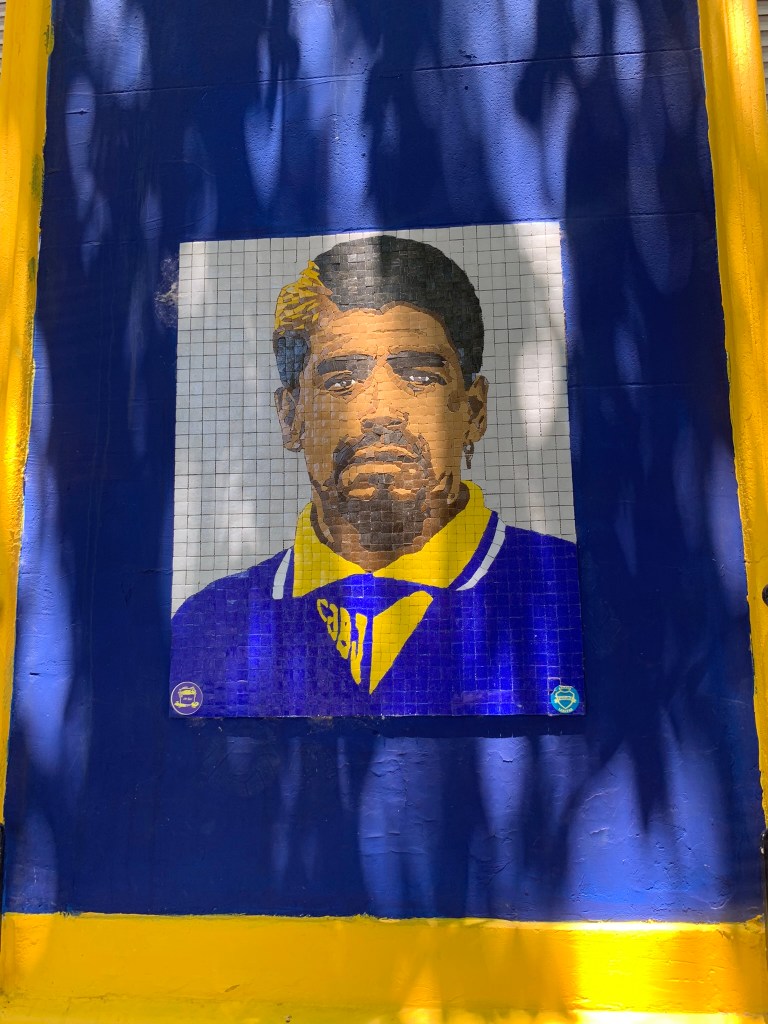
El Diego, La Boca barrio, Buenos Aires

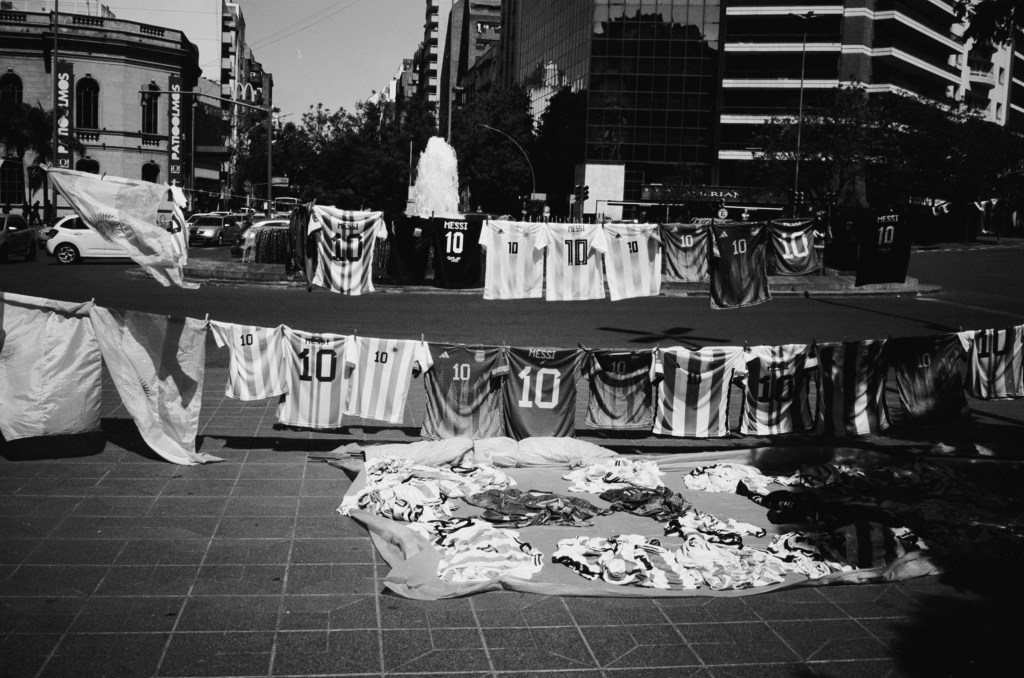
VUELVE LA CAMISETA QUE NUNCA SE FUE proclaimed a billboard on the outskirts of the city (‘the shirt that never left, returns’) advertising the 1986 World Cup home shirt, the one Diego Maradona wore as he skipped over the trailing legs of various opposition hatchet-men. I succumbed to one at a kiosk near the Kirchner Cultural Centre. The view on Maradona in the country was not as universally positive as I thought, though. It’s tempting to imagine him as the archetypal Argentine. But several people — hostel acquaintances, taxi drivers, walking tour guides — voiced the view that Maradona’s personal life counts against him decisively. This includes his drug use, his associations with the Neapolitan mafia, and his adultery. For some, Lionel Messi is preferred, for his loyalty to wife and family, his soft-spoken manner, the absence of obnoxious behaviour. Messi makes regular appearances on Argentinian television in adverts for things like big TVs and energy drinks. Slightly awkwardly, he insists to the viewer slogans like un futuro compartido (‘a shared future’), or una energia única en el mundo (‘an energy unique in the world’). And now, as the tournament developed, he found a new, organic catchphrase, directed at an off-camera Dutch player after the stormy quarter-final: Qué miras bobo? Anda por allá.‘What are you looking at, fool? Go over there.’

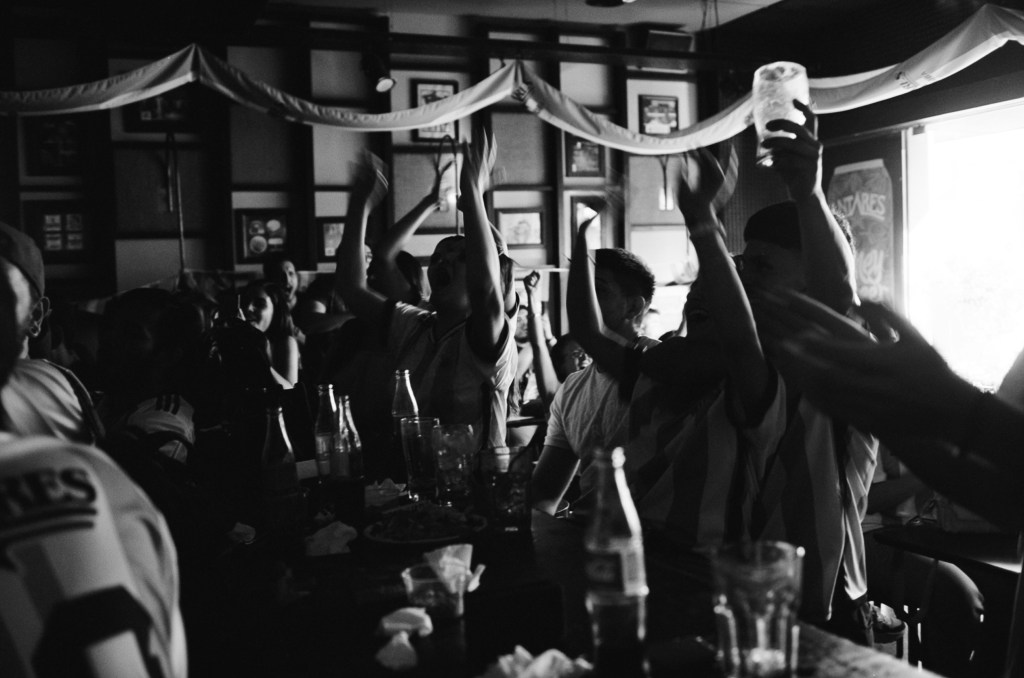
He looked like a man possessed after defeat in the opening game against Saudi Arabia, and that match quickly faded into irrelevance as the tournament progressed. I watched that game in the capital, or more accurately I watched the second half, not thinking it was worth getting up for a 7 a.m. kick-off when it seemed like it would be a walkover. I witnessed the stunning five-minute Saudi turnaround in the San Telmo neighbourhood with a group of disbelieving Argentinians. The unusually early kick-off probably tempered any overreactions from fans following the final whistle, and the mood in the city was neither overly angry nor mournful.

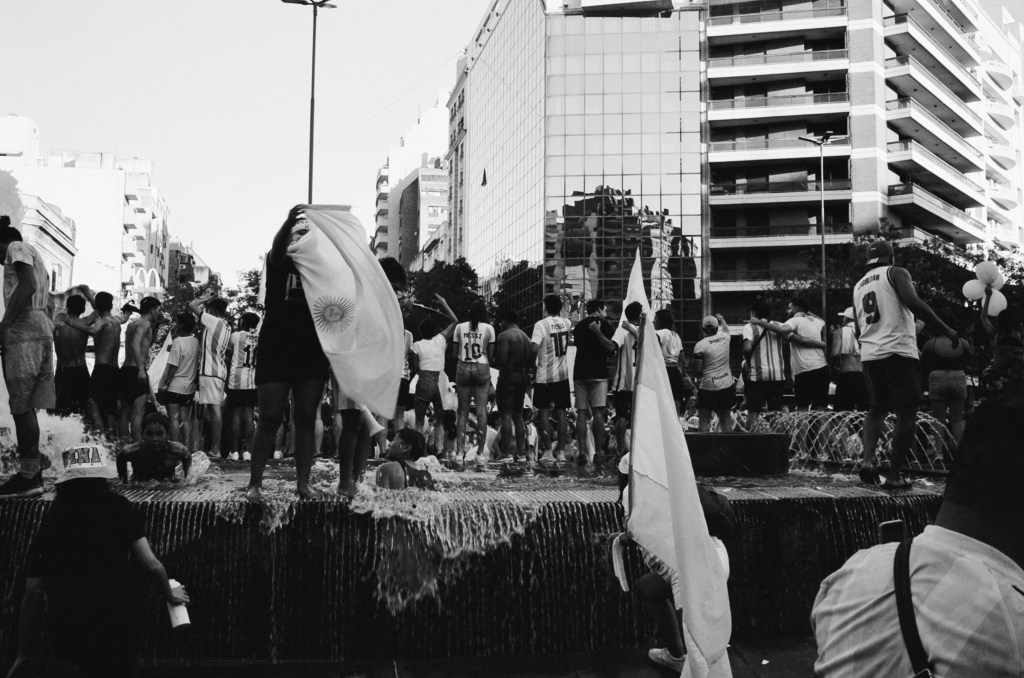
By the time of the Mexico game, I was in Córdoba, a large university city in the central north of the country. Following Argentina’s crucial win, a huge crowd arrived at Plaza Vélez Sarsfield, singing through megaphones, banging drums, and dancing in fountains. Having shown footage of the celebrations to UK-based friends and family, some joked that I should tell the crowds that it was only a group game they’d won. Here was one clear difference between our two football cultures – in England, no tournament victory before at least the semi-final stage would be received in this way, for fear of being made to look foolish later down the line. But in this public square, joy was being expressed in different ways by each individual, and the win signified an escape from pressures unique to each person.

Spot the theme, at Plaza Vélez Sársfield, Córdoba
The final whistle goes, Argentina 2–0 Mexico, Córdoba
Imagine what they’ll be like if they win it! The aftermath of Argentina 2–0 Mexico, Plaza Vélez Sársfield, Córdoba
…The celebrations continue

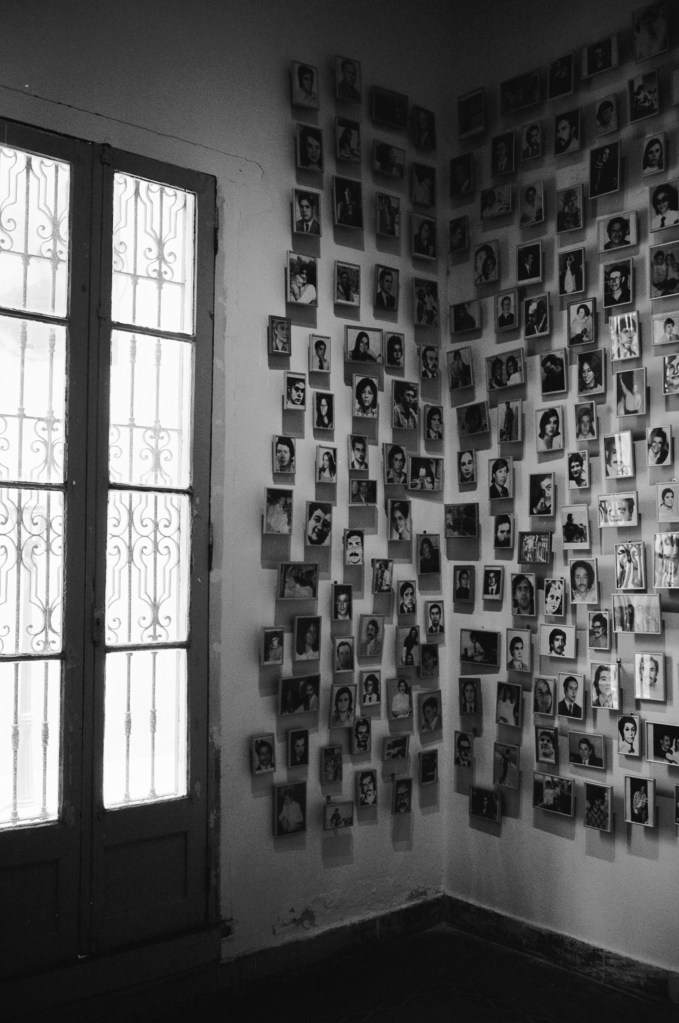
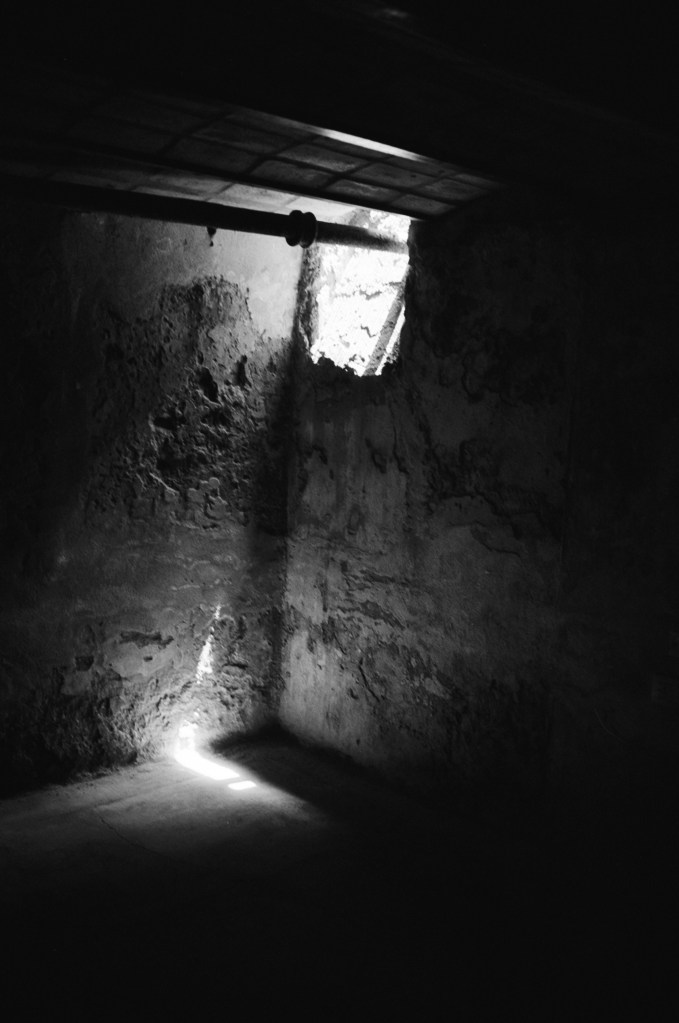
In Córdoba, as across the whole country, the sudden disappearances of the mostly young is a collective trauma which is still being processed in the national memory. The Museum of Memory plainly lists the names of those members of the special operations group at ‘D2’, the clandestine detention building which now houses the museum. Men with nicknames like ‘La Pantera’ (the Panther) and ‘Boxer’. And then there are their victims, children who they probably passed on the street, when they were simply children to these officers and nothing else, bidding them and their parents a good day. Mabel was 23 when she vanished on 10 July 1978; Monica was 25, María, 21. Here on display at the museum was what they left behind, their half-smoked cigarettes, cups of tea, dresses and jumpers left hanging in wardrobes, schoolbooks. Frozen in a glass cabinet, a diorama of innocent objects leaden with horrifying significance. Sus cortas pero intensas vidas, condensan sus deseos y luchas, sus pasiones y utopías … Their short but intense lives, condense their desires and struggles, their passions and hopes.

A simple mantra, repeated by the loved ones of the disappeared here and in countries like Chile during their dictatorship, is ­¿Dónde están? (‘Where are they?’) They are not alive or dead, said military leader General Jorge Videla back then. They are Disappeared.

Photographs of victims, Museo de la Memoria, Córdoba
An old cell in the basement of the clandestine detention centre, now the Museo de la Memoria, Córdoba

.

Dusty Córdoba, where the temperature hit 40 degrees, was followed by green Mendoza, where every avenue was tree-lined and bordered by distinctive deep cobbled storm drains. Here, I saw the final group game against Poland and the second-round game against Australia on a large outdoor screen on Avenida Aristides Villaneuva, jostling for view of it with thousands of others between the natural obstructions of trees, cars, and telegraph poles. Porro smoke hung thick in the air above teenagers on their summer break, cans of Quilmes, drums, backpacks facing frontwards. I would scan these blue-and-white crowds. Messi 10 Messi 10 Messi 10 (fake) Messi 10 De Paul 7 Messi 10. Rodrigo de Paul is so ‘Love Island’ that it’s uncanny – he has the exact correct number and position of tattoos, the right face, the right hair. And, hilariously, he was rubbish for the first two games, although he became a very effective midfield destroyer in later matches in this tournament, perfectly complimenting the creativity of Enzo Fernandez and Alexis Mac Allister. I shout-hummed the rousing last part of the national anthem, having not mastered the words. I had learnt a few other tunes, though:

Y ya lo ve, y ya lo ve, / ¡el que no salta, es un inglés! (If you don’t jump, you’re English!)

Anti-British sentiment is no trivial matter in Argentina – ‘English’ and ‘British’ are used interchangeably in this and many other songs – with references to the Malvinas/Falklands conflict found on signs in practically every town or village I went through, and even found in Argentina’s constitution. However, this animosity is aimed at British imperialism and should not be confused with hostility on a personal level. Not once was I made unwelcome by any of the countless people who I had conversations with in the country, even those who were particularly angry about the war.

After travelling from Mendoza to Salta in another long bus journey punctuated by traffic jams and arbitrary stops, the desire to operate on my own timetable overcame my fear of driving, so I rented a car in Salta with two other Brits. Here, as in Buenos Aires, queues snaked out of every bank all day, and cashiers would check if I wanted to pay for my grocery shopping in one upfront payment. I had learnt of the so-called ‘Coldplay dollar’ exchange rate for paying to see foreign artists perform in Argentina, one of many levies on transactions involving foreign currencies (Coldplay were inflicting ten consecutive nights of concerts upon Buenos Aires around this time). Every tariff penalising the outflow of money is ascribed its own ‘X-dollar’ name format in this way. In a half-hearted attempt to stall fears over inflation while the tournament was taking place, Argentina’s Minister of Labour said ‘First, Argentina win, then we will continue working […] one month is not going to make a big difference’.

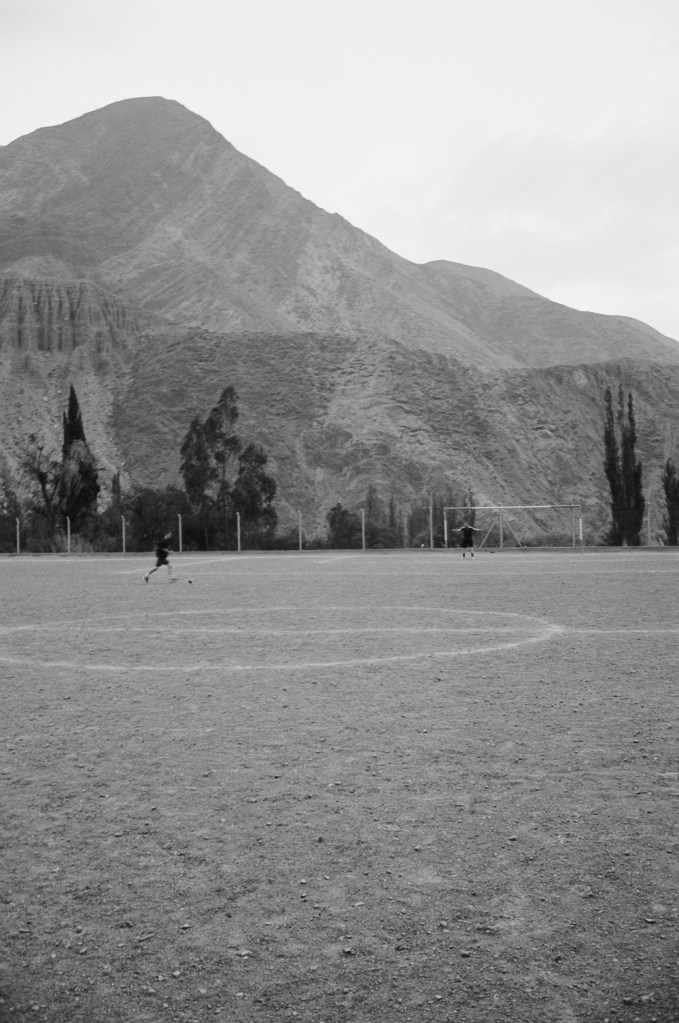
The provinces of Salta and Jujuy lie in the north-western corner of Argentina, and the border with Bolivia and centre of the continent feels close. The patchwork multicoloured Andean Wiphala flag emerges here, flying from buildings and daubed on walls. In the town of Purmamarca, the adobe buildings seem to be carved out of the rock itself, and all around the town, rock formations in psychedelic green, blue and red hues stand side-by-side impossibly with one another. Inside our car, vapour rose from yerba mate leaves singed by the thermos water. We stopped at every viewpoint we could, taking it all in. We visited La Garganta del Diablo (‘The Devil’s Throat’), one of many in South America. Standing in it and looking all the way to the end, it was like a red amphitheatre turned on its side. Looking outward, a section of sky tore through the middle of the rising rocks as if they were paper.

Fresh Drinks, Purmamarca, Jujuy Province
Acres of space … at Purmamarca, Jujuy Province

Needing to sort out my route with some notice to avoid exorbitant price hikes, I had taken a chance on Brazil reaching the final, and so had planned an excursion to Rio de Janeiro. After Croatia knocked them out, I had to move this trip forward to ensure I would be in Buenos Aires for the final. This meant I sacrificed watching Argentina’s semi-final, my flight leaving for Brazil at the same time as it kicked off. The mood on the plane went from nervy to jubilant in five first-half minutes, with the pilot happily relaying the news of two quickfire Argentina goals to his passengers.

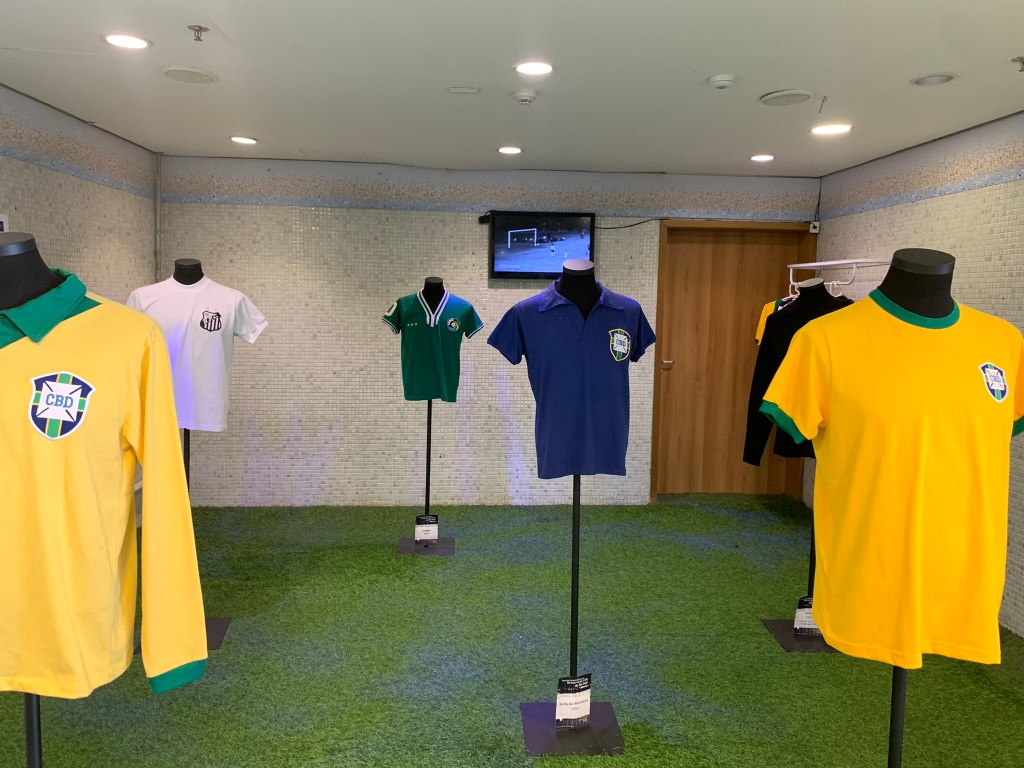
In Rio, I visited the Maracanã. In the depths of the stadium, I saw the cast footprints of the Uruguayan Alcides Ghiggia, recently deceased, scorer of the winning goal in the Maracanazo (‘Maracanã Blow’), a term used to describe the events of 1950 World Cup final between Brazil and Uruguay. Pitchside, I asked the guides which end Ghiggia scored at, but nobody there knew. The stadium, resplendent with blue and yellow seating and holding only half the capacity it once had, looks very different to the image from that 1950 final, the image. Ghiggia beginning to run away in celebration, the tired anguish on the face of the Brazilian defender as an arm rises to cover his head, the dark ball already rolling up the back of the netting, 200,000 home spectators slanting upwards from the pitch like a dark hill, silent in the background, lost in the fog of image resolution — witnesses to a disaster unfolding. Somewhere else at that same moment, a nine-year-old Pelé comforted his weeping father and made him a promise.

Some of Pelé’s matchworn shirts, Maracanã stadium, Rio de Janeiro

Back in Buenos Aires in time, I watched what was surely the greatest World Cup final of them all, at Plaza Mayor Seeber. From the 80th to the 120th minute, Kylian Mbappe put in one of the most menacing, rain-on-your-parade performances I have ever seen. The directness of his approach induced panic and caused Argentinian defenders’ motor functions to misalign. All this, having done almost nothing of note since the Poland match in the round of 16. Argentina deserved the win, and I was glad the game wasn’t settled on what seemed a very soft penalty for the game’s opening goal — the fifth by my count that they had been awarded in the tournament, ranging from marginal to scandalous (see again: Poland).

In the square where thousands came to watch it, one man was told to stop waving his huge flag because he was blocking people’s view. He obliged with a smile, waited for the complainant to walk away, then raised it again with cowardly bravado, offering out everyone and no one. In between full time and extra time I walked around the dazed square, taking pictures of the general anguish. France were right to go for the win in extra time, because there was only ever going to be one winner once it went to penalties. Two French men wildly celebrated Mbappe’s first equaliser next to me and were then very gracious to me in Spanish, assuming I was a stunned Argentina fan. Extra time was absurdly open, unprecedented for a World Cup final, making even the 2018 final seem cagey in comparison.

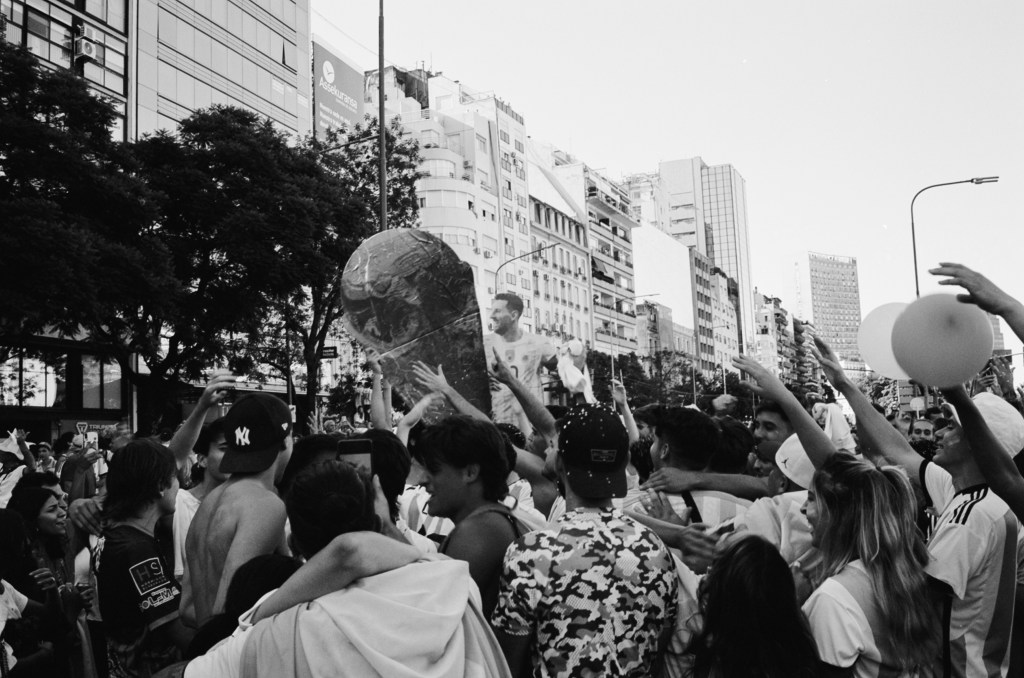
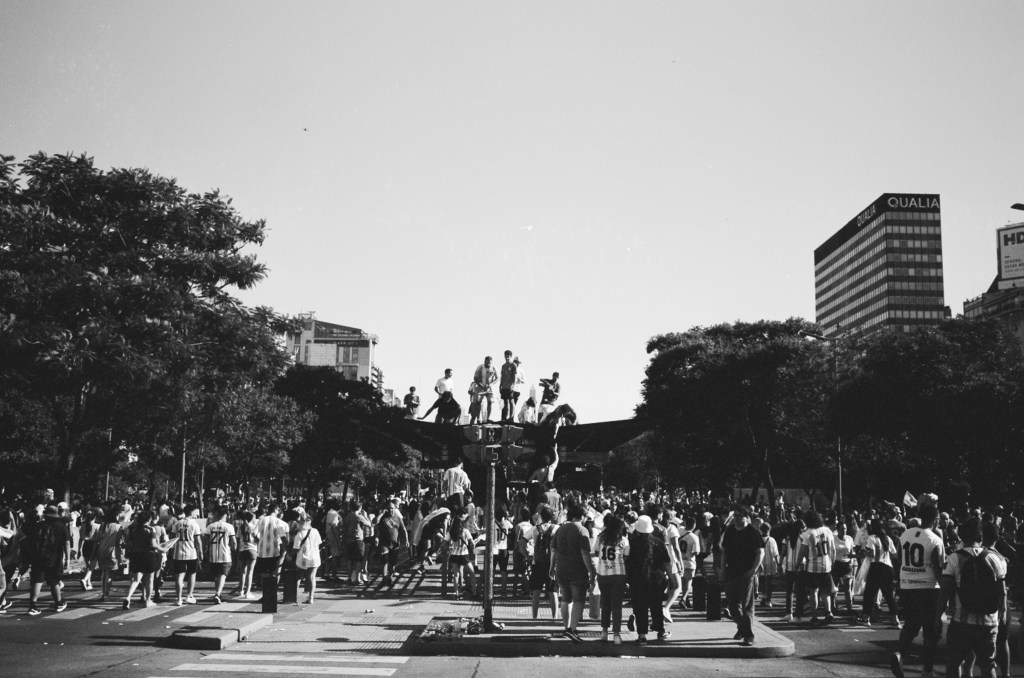
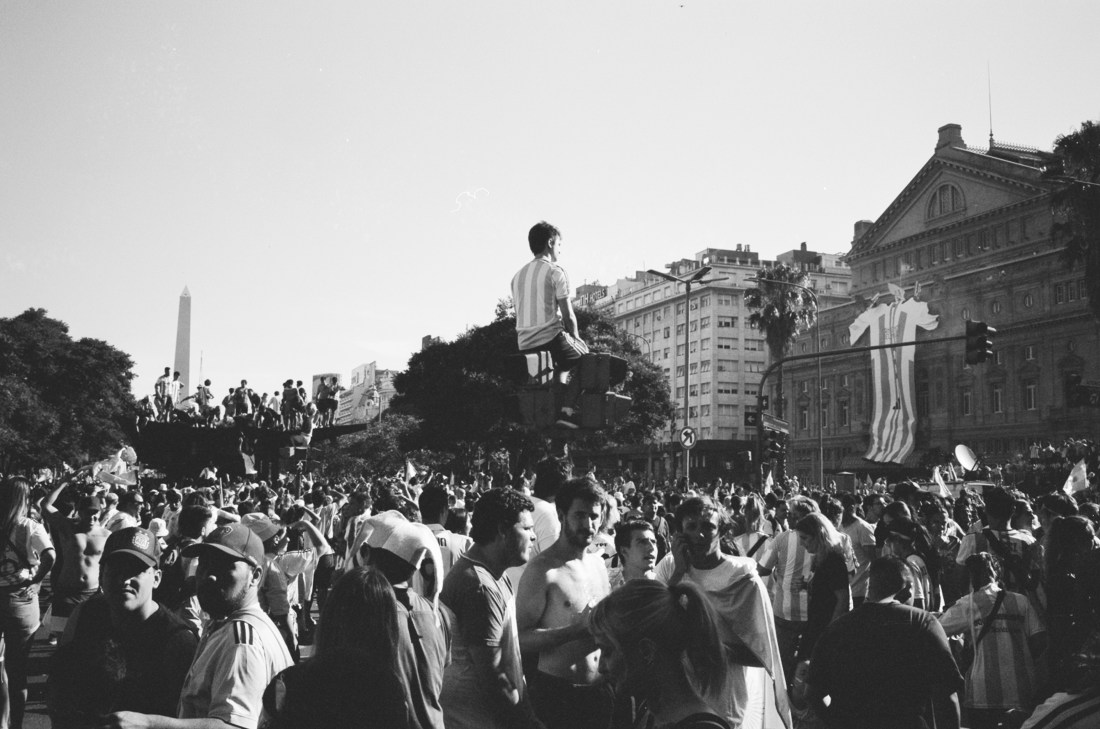
Having watched Messi lift the trophy at long last, thousands of us headed south to Avenida 9 de Julio where the famous Obelisk is located. On the Avenida, cars lay frozen in time abandoned by their owners, and people occupied every available flat surface like snowfall — traffic lights, bus stops, roofs, lampposts.

Y ya lo ve / ¡El que no salta es un francés!

Marching towards Avenida 9 de Julio
Godlike … on Avenida 9 de Julio

On my final day in the city, the team were due to parade the trophy through these same streets. Four million people were there to meet them. There was a shimmer of white police helmets as a motorcade assembled on an overpass a quarter of a mile away. People drank fernet out of two-litre bottles sliced in half. The occasional mirage of a bus somewhere in the distance provoked surges forward in the crowd but it was never the real thing. A bottleneck formed behind me (I now know that this was in response to the news that the parade had been abandoned and the players evacuated) and the lamppost-people, back after a day’s normality following the game, marshalled the huge mass beneath them. Breathing space appeared and disappeared quickly. But the celebration continued, unmoved by the bad news. Clearly, the day was about much more than getting to see the gold glint of the trophy. Crowds formed in side streets where residents of the flats overhanging the street showered them with refreshing cold water. Drummers hammered out a marching rhythm, repeated infinitely, and the people sang gleefully:

Muchachos! / Ahora nos volvimos a ilusionar / Quiero ganar la tercera / Quiero ser campeón mundial!

‘Boys! / Now we get excited again / I wanna win the third / I wanna be world champion!’

These are the sights and sounds that will stay with me forever.

Rodrigo de Paul had summed it up it well after the game, standing on a pitch thousands of miles away: ‘We suffered a lot, but it feels so good. We were born to suffer, it hardens us, as we are going to suffer all our lives.’

The Thousand-member Jury: How Reddit is used in an ongoing criminal trial

We say the collapses and deaths of the 17 children named on the indictment were not normally occurring tragedies. They were all the work, we say, of the woman in the dock who we say was a constant malevolent presence when things took a turn for the worse for these children’ – Nicholas Johnson KC

We say that if an expert sets out within expectation a suspicion of harm being done, that may make it more likely they will reach conclusions which are harm based […] rather than innocent explanations.

When there is no explanation, there is a danger of the expert filling the absence of an explanation with one […] by the prosecution.’ – Ben Myers KC

It is not difficult to understand the high level of public and media interest in the ongoing trial of Lucy Letby. The neonatal nurse is accused of murdering seven babies and attempting to murder 10 others at the Countess of Chester Hospital between June 2015 and June 2016. She denies all the charges. If the prosecution’s arguments are proven, then the alleged victims were the most vulnerable targets imaginable – babies born prematurely or with other medical complications. And the alleged perpetrator was someone who they were at the mercy of, and in whom their parents would have placed complete trust. In recent years, cases involving grave abuses of authority in the UK have led to public outrage and debates about the structural failings of institutions tasked with protecting people, such as in the Metropolitan Police. On the other hand, Letby’s defence claims that she is being wrongly blamed for the inadequacies of care at the hospital, and that her colleagues have linked her presence on the unit with the deaths to suit the narrative of her guilt in retrospect. Whatever the outcome, the stakes are high.

The specifics of this intricate trial are already being extensively covered by publications like The Daily Mail, The Chester Standard, and Cheshire Live. However, in the age of Twitter, minute-by-minute court reporting, and a boom in true crime podcasts, non-traditional sources of information are often turned to in order to address gaps in the public’s knowledge. Reddit is a good example of this – the Letby case, like many others, has its own dedicated community which typifies a subreddit’s ability to offer what other news sources do not.

At the time of writing, r/lucyletby has over 1,100 members. When the trial began, there were just 8 members; by its second week, 471. Though this is a UK case in an NHS hospital setting, it has clearly attracted attention from people in other countries as well. The community features posts from those claiming to be UK-based NICU (neonatal intensive care unit) nurses and other medical professionals (the anonymity of Reddit makes this unverifiable), but also from those claiming to be American hospital workers who are interested in the case and in the differences between the two countries’ healthcare systems.

One clear draw for users of the subreddit is the advantages that anonymity offers. In an interactive anonymous space, users can speak more colloquially and plainly, and ask the more unusual and particular questions about the case that may not be answered in newspaper reports. Anonymity is also useful amid a prevailing societal suspicion of people’s ‘morbid fascination’ in true crime stories. On the subreddit it is tacitly acknowledged that people are ultimately just interested in a case where such a level of ‘interest’ may be seen as distasteful. Here, redditors can ask questions which haven’t been posed by reporters, the defence, or the prosecution: ‘How long did Lucy know she was under suspicion before the first arrest?’; ‘What happens to the jury at the end of each day?’. Intermittent polls are taken to survey opinions on Letby’s guilt or innocence, based on the trial evidence hitherto reported on. Redditors will often invoke their professional or personal experience to give different perspectives. To give a striking example, one post is titled ‘My Grandfather almost killed me as a baby, and I can relate to this story. *TW* [trigger warning]’.

Perhaps the clearest example of the subreddit’s preoccupation with filling in supposed gaps are the many discussions centred around possible motivations: what are the actual reasons Letby would have to carry out the attacks? This is a reaction to the absence of an overarching narrative provided by the prosecution so far in the trial which would tie all their evidence together and would present a compelling motivation for the alleged crimes. A post-it note shown to the court on day four of the trial which documents Letby’s thought process around the time she was being investigated by the police has been reported by some newspapers in a way which suggests a possible motive. However, in r/lucyletby the discussion over the meaning of the note is more sober and many argue that it is not as significant as reported. Ultimately, though, discussions like these are speculation and highlight the limitations of a subreddit acting as a kind of extended jury. A court order issued at the start of the trial gives anonymity to the victims and their families, making it difficult for those outside the courtroom to establish similarities between victims which could aid in creating a narrative.

While the subreddit’s knowledge of the case is incomplete when compared to what the jury is hearing, it is arguably a better tool for information gathering than many other news sources. Ongoing trials are an ever-growing mass of information, and perhaps Reddit is the format best suited to this kind of changing news event. The community collates together diverse sources that range from freedom of information requests for neonatal death statistics at the Countess of Chester Hospital, to daily round-ups of newspaper articles, to event timelines and live court reports. As the subreddit’s moderators told me, ‘Reddit differs from other formats in a few ways. First and foremost among them is its ability to organize information […] Pinned topics allow for quick references of the most useful information, rather than having to search through an ongoing thread of discussion. A well-organized forum could achieve this, but in my experience, few do.’

Asked if their own opinions on the case have been directly influenced by discussions on the subreddit, they replied ‘Absolutely. Users on this sub pointed out statements that, upon reflection, were more vital than I realized based on the reporting covered.’ They conceded, however, that the capacity of the subreddit to organise discussion in a helpful way according to the merits of the information had its limits:

‘In theory, the result of the upvote/downvote system is that the cream rises to the top […] In practice, it often results in the most popular discussion rises to the top. However, I think that in general, in a subreddit whose point is to differentiate fact from fiction and proof from lack thereof, I think there is a lot of overlap between helpful and popular, much like how a jury would deliberate.’

The community must abide by a few limited external rules, but for the most part is self-regulated, adding to its sense of being a community whose essence is in constant flux. In the internet age, UK contempt of court laws have adapted to cover situations such as social media posts prejudicing the jury by revealing unknown information about the defendant, which would fall under ‘conduct obstructing or calculated to prejudice the due administration of justice.’ During high-profile trials, the Attorney General will often issue a media advisory notice to ‘Editors, publishers and social media users’, asking that they ‘fully comply with the obligations to which they are subject’. As the community is largely dealing with information already reported by journalists attending court, it is unlikely that anything discussed on r/lucyletby would be deemed contempt of court. Nevertheless, the community rules re-state the need to abide by the court order by not discussing the identities of victims or families.

The ‘culture’ of a subreddit is often as important as the rules it enforces, and discussion in this community is largely nuanced, discourages conjecture, and is civil. Recently, though, a rule to combat misinformation has been added by the moderators: ‘Misinformation/disinformation is not permitted. Comments flagged by users as containing misinformation or disinformation will be identified as such.’ This rule is further clarified by a moderator: ‘This is not meant for differences of opinion, but for actual, disprovable facts or critical missing context.’ Like many other subreddits, r/lucyletby makes liberal and demonstrable use of the edit tool, not only to regulate itself but to appear transparent in the steps it takes to self-regulate. As an example, one member asserted that there was no evidence that the unit was downgraded to a level 1 (only caring for babies delivered after 32 weeks) in June 2016. Moderators flagged this as false information, with evidence to show that it was indeed downgraded at this time, around the same time that Letby was transferred to clerical duties. This is a key distinction to make, as it undermines the prosecution’s assertion that Letby’s departure from frontline working coincides with, and is therefore linked to, the subsequent drop in suspicious deaths on the unit after June 2016.

In an acknowledgement that the medical experience called upon by some community members, while helpful, cannot be verified, a further rule states that ‘Analysis of evidence based on a commenter’s personal professional experience should be posted in its own thread.’ Expanding on this idea, the moderators told me that ‘How they self-identify may give the air of legitimacy to their comments, but, ideally, the reddit upvote/downvote and comment [and] reply format are a check against misinformation.’

r/lucyletby is not a place with unique access to the facts of the case, but it is a platform which organises information alongside candid user discussion of the case. As the moderators concluded, ‘whatever the verdict is, people will perceive the trial and the evidence how they choose. The discussion will not end when the trial does […] I believe that we can universally agree that we hope justice is served through the outcome.’

The trial continues.